Police Body Camera Transcript: The Defense Attorney's 2026 Guide
Key Facts
- Axon's bodycam database grew from roughly 6 terabytes in 2016 to more than 100 petabytes by 2024, most of it never watched by a human, according to NPR.
- Manual review of a single bodycam video takes 4 to 6 hours, per workflow estimates, a burden no defender can absorb across a full discovery dump.
- Departments letting officers watch footage before writing reports fell from 92% in 2019 to 56% within five years, per R Street Institute research.
- A Wisconsin defense attorney turned 30 hours of transcribed footage into a serious motion to dismiss before jury selection, Axios reported.
- Stanford researchers predicted handcuffing, search, or arrest from just the first 27 seconds, roughly 45 words, of a traffic stop, per NPR's reporting.
- About 30 police agencies, including NYPD, run Truleo's AI analysis on their own bodycam footage at roughly $50,000 per department per year, per Undark/ProPublica's investigation.
- Roughly 40 public defender offices have institutionalized AI bodycam review tools like JusticeText, per Axios.
The Discovery Burden Nobody Can Watch: Why Bodycam Volume Broke Manual Review
The numbers stopped being human-scale years ago. Axon's footage database grew from roughly 6 terabytes in 2016 to more than 100 petabytes by 2024, and according to NPR's reporting on body camera review, the vast majority of that video is never watched because human review simply cannot keep pace.
You already know what this feels like on your end. Manual review of a single bodycam video runs 4 to 6 hours, per workflow estimates on body camera incident summaries, and that clock starts after you've already spent the day on hearings, jail visits, and client calls. Multiply one video by a case with three officers, a dashcam, and an interview room, then multiply that by the hundreds of clients a public defender carries at any given moment. The arithmetic doesn't work. It never did.
The discovery dump doesn't shrink to fit your calendar, either. Here's what actually lands in your lap on a contested case:
- Multiple officer bodycams, each with its own timestamp drift and file-naming chaos
- Dashcam and interview-room footage of the same event
- Jail calls and 911 audio that may or may not match the report narrative
- Police reports, supplements, and scanned documents with no text layer
Something has to give, and right now it's the footage. A police body camera transcript workflow is how you get through it, because it converts hours of unskippable video into searchable, timestamped text you can actually work with. That's the difference between reviewing discovery and surviving it.
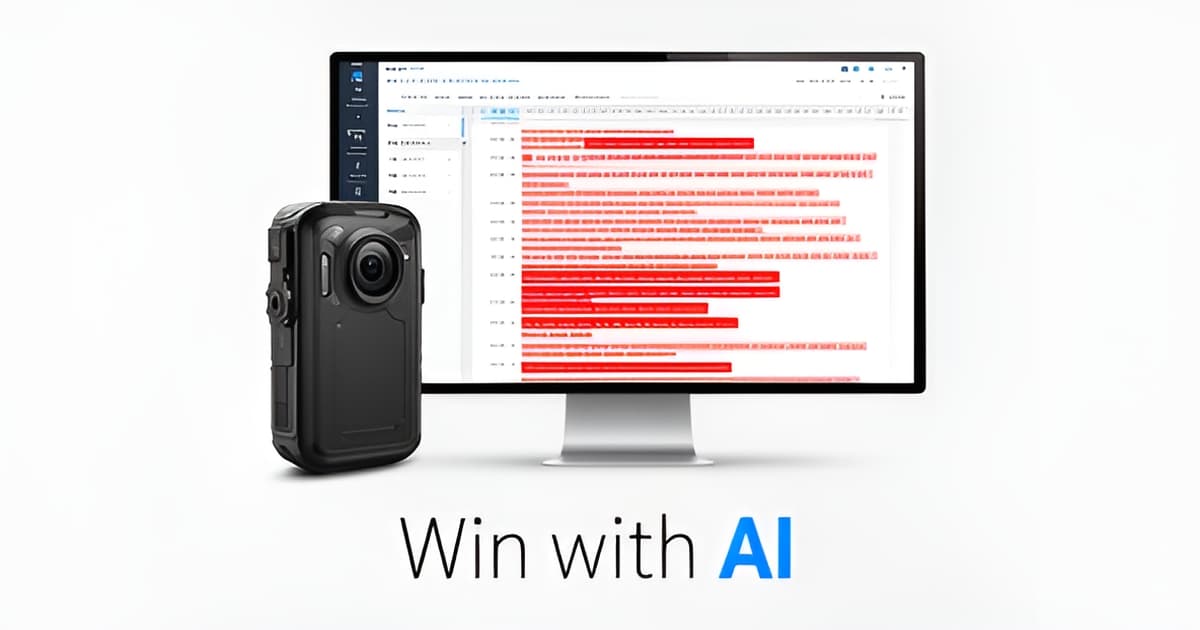
This is where a grounded review workspace earns its place. With body camera footage review built around timestamped diarized transcripts and an evidence agent that cites the exact second of video behind every answer, you stop scrubbing timelines and start comparing the report against what was actually said. For offices handling volume, bodycam analysis for defense attorneys turns that same transcript into contradiction signals before anyone asks. Every AI output is marked for human review, and originals stay untouched.
What a Bodycam Transcript Is Actually Worth: Report-vs-Footage Contradictions and the Pre-Review Shift
The real value of a police body camera transcript isn't a written record of what was said. It's a timestamped map that lets you line up what actually happened against what the officer wrote in the report. That comparison is where suppression motions and cross-exam outlines come from.
When officer testimony or the police report conflicts with bodycam audio, those discrepancies "often become the foundation for suppression motions or cross-examination strategies," according to Clio's analysis of criminal-defense AI use. The work is mechanical once you have the transcript: search for the phrases that decide cases, then check them against the report narrative.
The documented results are hard to ignore. Madison, WI defense attorney Jessa Nicholson Goetz received 30 hours of audio and video before jury selection. With everything transcribed and searchable, she located "substantial and significant problems with the police conduct that have led to a serious motion to dismiss," as Axios reported. Thirty hours of footage, manually reviewed at the typical 4 to 6 hours per video, would have consumed her entire prep window. Searchable text changed the math.
Here's the policy context that makes contradiction-hunting even more productive. In 2019, an estimated 92% of departments let officers watch their own footage before writing a report or giving a statement. Within five years, that figure fell to 56%, per the R Street Institute. Critics of pre-review argue it lets officers align their statements with the footage rather than give a contemporaneous account, a distinction that matters most in use-of-force investigations.
For you, this cuts two ways:
- In pre-review jurisdictions, expect the report to match the footage on surface details, so hunt for what the camera captured that the report omits or reframes.
- In no-pre-review jurisdictions, the report is a memory document, and honest discrepancies between recollection and recording are impeachment material.
- Either way, find the local policy early and consider discovery requests for any pre-review documentation.
A timestamped transcript makes both tasks tractable. Tools built for bodycam analysis for defense attorneys, including Evidence Copilot, surface candidate report-versus-footage inconsistencies as review signals on ingest, before anyone has to go looking. From there, structured body camera footage review turns each flagged discrepancy into a quoted, cited moment you can drop into a motion outline or a cross-exam draft. The attorney still verifies every excerpt against the source video, but the finding work that used to take days now happens before you've finished your first cup of coffee.
The Other Side Has AI Too: Truleo, Discovery Obligations, and New Brady Angles
Roughly 30 police agencies now run Truleo's AI analysis on their own bodycam footage, including NYPD after an October 2023 pilot, at a reported cost of about $50,000 per department per year. The findings stay inside the agency, often shielded by NDAs and kept confidential. That asymmetry should change how you approach discovery in any case where the investigating department has a Truleo contract or similar tool.
Start by serving targeted discovery requests asking whether the department used any AI-based analysis on the footage in your case. Request the raw output: flagged timestamps, behavioral scores, any reports shared with supervisors or internal affairs, and any communications between the department and the vendor. Under Brady and Giglio, an agency's undisclosed AI analysis of officer conduct sits in the same evidentiary space as supervisor notes or early internal-affair referrals. If the prosecution turned over the video but not the analysis layered on top of it, that's a preservation and disclosure problem you can raise.
The behavioral research sharpens cross-exam in a different way. Stanford researchers analyzed nearly 600 Oakland traffic stops and found they could predict whether a driver would be handcuffed, searched, or arrested from the first 27 seconds of the encounter, specifically the first roughly 45 words the officer spoke. Stops were more likely to escalate when officers opened with commands instead of explanations. Truleo's own scoring rewards officers who use more than 25 words to explain something. That gives you a framework for cross-exam:
- Pull the first 30 seconds of the stop and count the officer's words before any question or command.
- Compare the opening to the police report's narrative of how the encounter began.
- Ask the officer on the stand whether they were trained on de-escalation opening protocols, and whether the department tracks that data.
- If the department uses Truleo or a similar tool, ask whether the officer's footage was reviewed by AI, and whether any feedback was given.
Two practical cautions. First, researchers studying Truleo flagged that officers may "play the game according to Truleo's rules," meaning surface-level compliance without genuine change. That's useful for arguing why the officer's in-court demeanor proves nothing about the stop itself. Second, the Union County and Philadelphia story cuts both ways: where unions have blocked AI discipline, you can argue the department has no reliable internal check on the conduct you're challenging. Where AI analysis exists and is hidden, you argue the opposite: the data exists, the State is sitting on it, and the jury should hear about it.
For defenders building this into a standard workflow, the practical move is to treat AI-flagged footage the same way you'd treat a confidential informant file or a use-of-force review board report: discoverable, preservable, and impeachable if withheld. Tools built for bodycam analysis for defense attorneys let you run the same first-27-seconds timing exercise across every stop in a case file, so you can pattern-match an officer's openings across multiple incidents rather than relying on a single encounter. That kind of cross-case consistency check is exactly what the prosecution's AI review is doing on the other side, and it's what your body camera footage review workflow should match.
Ethics and Admissibility: Using AI Transcripts Without Getting Burned
You can't cite a transcript you haven't verified, and you can't verify what you haven't watched. That's the whole ethics problem with AI-generated police body camera transcripts in one sentence.
ABA Formal Opinion 512 (2024) sets the national baseline, and Model Rules 1.1, 1.6, 3.3, and 5.3 all point the same direction: every AI output gets attorney review before it reaches a client, a court, or opposing counsel. Mata v. Avianca remains the cautionary tale on fabricated citations, and the 2026 Heppner decision flagged something newer and quieter: sloppy use of consumer AI tools can risk waiving attorney-client privilege. That's why legal-specific tools with zero-data retention and no-training commitments matter more than convenience features.
FRE 901 and 902 haven't moved. A transcript helps you find the moment; it doesn't authenticate the recording, and it doesn't excuse you from the rules that govern admissibility.
So build the workflow to survive a challenge:
- AI generates the timestamped, diarized transcript from the source video.
- You pull up the cited timestamp and verify each key segment against the original footage yourself.
- Only verified excerpts become work product: cross-exam questions, suppression motion language, impeachment material.
- Every citation resolves to the exact second of video or page of the PDF, so verification is a click, not a re-watch.
- Originals stay immutable and every action stays audited, which is the record you want if the other side asks how a transcript was produced.
That last point is where a real body camera footage review workflow separates itself from a chat window. Manual review runs 4 to 6 hours per video, according to workflow estimates from CaseMark, and no defender can absorb that across a full discovery dump. AI compresses the finding; your eyes on the footage do the verifying. If you want to see how that plays out on a real case file, bodycam analysis for defense attorneys walks through the full review-to-motion pipeline.
The discipline is simple, and it's the same discipline Rule 3.3 has always demanded: AI finds, you verify, verified excerpts become the record. Skip the middle step and you're not saving time. You're just borrowing it from your bar license.
A Working Transcript Workflow: From Upload to Cross-Exam Draft
You've got 40 hours of discovery and a preliminary hearing in two weeks. Here's the workflow that gets you from a discovery dump to a draft cross-exam without watching every second at 1x speed, given that manual review of a single bodycam video typically runs 4–6 hours per video.
Step 1: Upload everything, in one place. Email the discovery files to your case's inbound address or drag them in by web upload, up to 2 GB per file. Bodycam video, the police report PDF, the 911 call, jail calls, photos. Scanned reports with no text layer get OCR'd into searchable, citable text automatically.
Step 2: Get a real transcript, not a wall of text. Every audio and video file is transcribed with speaker diarization and word-level timestamps. Rename "Speaker 2" to "Off. Ramirez" once and it propagates across every segment. Now you have a police body camera transcript you can actually search and cite to the exact second.
Step 3: Let the inconsistencies come to you. On ingest, every new file is compared against what's already in the case. Report-vs-bodycam contradictions surface as review signals before anyone asks a question. This matters more than it used to: R Street's research found departments permitting officers to review footage before writing reports dropped from 92% in 2019 to 56% within five years, which means report-vs-footage gaps are both more common and more impeachable.
Step 4: Search the phrases that win motions. Full-text search across transcripts and documents means you can pull every instance of the phrases that matter in seconds:
- "I did not consent" for search and suppression issues
- "hands up" and "get down" for use-of-force sequencing
- Miranda language for custodial-interrogation timelines
- Officer statements that conflict with the report narrative
Step 5: Sync the cameras. Link bodycam, dashcam, and interview-room footage of the same event to one master clock. Sync proposals are computed from word-timing correlation and reported with match evidence like "31 word matches, ±0.2 s spread" before you accept anything.
Step 6: Draft the cross. From any review signal, generate suggested cross-exam questions. Every question is tied to a quoted source, both sides' words included, and saved as an attorney-review note. No credibility conclusions. You verify the segment against the source video, then take it to the witness.
That's the core of body camera footage review as a repeatable process, and it's what bodycam analysis for defense attorneys looks like when it's built for the defense side of the table. Every AI output is marked AI-generated and pending human review, and originals stay immutable.
Pricing is published, with no sales wall: Solo at $39/user/mo, Firm at $99/user/mo, and a PD Office tier at $750/attorney/year. Every plan includes the full workspace. You can start with a 7-day full-access trial, no card required, or book a 20-minute walkthrough at evidencecopilot.com/book and see the workflow run on your own case first.
Frequently Asked Questions
How long does it actually take to review a bodycam video manually?
Is it ethical to use an AI-generated police body camera transcript in court?
Can a bodycam transcript actually help me win a suppression motion or cross-exam?
Do police officers get to watch their bodycam footage before writing their reports?
The police department ran AI analysis on my client's bodycam footage, can I get that in discovery?
What's the first thing to look for when cross-examining an officer on a traffic stop?
The Footage Isn't the Problem, The Finding Is
Manual review of a police body camera transcript workflow collapses hours of unskippable video into searchable, timestamped text you can actually work with. That's what turns report-vs-footage contradictions into suppression material, what makes the pre-review policy question worth asking early, and what keeps you from being outgunned by the other side's AI. The discipline hasn't changed: AI finds, you verify, verified excerpts become the record. What's changed is the volume, and with it, the cost of doing this by hand. If you want to see how that plays out on your own case file, Evidence Copilot's bodycam analysis for defense attorneys walks through the full review-to-motion pipeline, and structured body camera footage review shows the workspace end to end. Book a 20-minute walkthrough at evidencecopilot.com/book and bring a real discovery dump, no card, no pitch, just the workflow on your evidence.