Police Report Discrepancies Lawyer: The Defense Attorney's 2026 Guide
Key Facts
- 92 senior law enforcement reviewers rated AI-drafted police reports significantly worse on accuracy (p = .038), dropping them from the 50th to the 36th percentile.
- About half of AI-generated police reports in Oklahoma City PD training required officers to fill in missing information before submission, per the DOJ's COPS Office.
- AI report tools transcribe bodycam audio only and cannot parse visual content, so anything the officer didn't narrate aloud can't appear in the report, the COPS Office confirms.
- An OKCPD AI report captured zero dialogue from a non-English-speaking individual, only the English-speaking victim's words, according to Chief Redfearn.
- Half of prosecutors across four Oklahoma counties were hesitant about AI reports, waiting to see how defense attorneys attacked them in court, Captain Jason Bussert reported.
- NACDL calls inconsistent statements and omissions "the greatest weapons in the defense team's credibility arsenal" for challenging officer credibility.
- No court has ruled on the admissibility of AI-written police reports yet, leaving the question explicitly unresolved.
The New Discrepancy Landscape: AI-Drafted Police Reports Change the Game
Something changed in your discovery packets this year, and if you're a police report discrepancies lawyer who hasn't adjusted, you're already behind. Axon's Draft One and Truleo's Field Notes are now drafting police reports directly from bodycam audio, and the reports landing in your inbox may never have been written by a human at all.
The deployment is real, not theoretical. Boulder PD ran a one-year pilot before expanding Draft One to all sworn personnel, and has used it on cases as serious as a violent domestic and a sex assault, according to the DOJ's COPS Office. The software pulls bodycam footage, transcribes the audio, and produces a full narrative in minutes.
Here's the structural flaw every defender should understand: these tools transcribe audio only. They cannot parse or summarize the video's visual content. The report is a record of what the officer chose to narrate aloud, not what the camera actually showed. If the officer didn't say it, it isn't in the report. That turns every AI-drafted narrative into a curated account, and every unspoken visual fact into a candidate discrepancy between report and bodycam.
The accuracy claims don't hold up well either. A study of 92 senior law enforcement reviewers (sergeants and above, averaging 22 years of report-approval experience) rated AI-assisted reports significantly worse on accuracy, p = .038. The effect dropped reports from roughly the 50th to the 36th percentile on perceived accuracy. Tellingly, reviewers couldn't tell which reports were AI-written at better than a coin flip, yet still rated the AI drafts as less accurate.
The ground-level data matches. In Oklahoma City PD's own training, about half of AI-generated reports required officers to fill in missing information before submission. Those officer-supplied gaps are exactly where omissions live, and omissions are impeachment material under the same framework you already use for human-written reports.
Documented failure modes worth probing on cross:
- Non-English speakers: an OKCPD AI report captured only the English-speaking victim's words, with no dialogue from the other party.
- Degraded performance with longer interviews, pursuits, and traffic accidents, per customer reports cited by the ACLU.
- Loud environments and interjecting audio, such as radio chatter, corrupting the transcript.
And here's the part that should shape your strategy: prosecutors don't know how these reports will survive either. When OKCPD met with District Attorneys across four counties and a U.S. Attorney's office, Captain Jason Bussert reported that "half of them liked it and the others were hesitant because they wanted to see how defense attorneys attacked the report and how it played in court." Admissibility remains unresolved, and no court has ruled on it yet.
So add one question to your intake checklist: was this report AI-generated? If it was, request the underlying bodycam audio, the officer's edits, and the vendor's disclosure records immediately. A structured AI police report analysis workflow that flags report-vs-bodycam gaps on ingest makes that comparison tractable at case scale; Evidence Copilot pricing is published, with a PD-office tier under $750 per attorney per year. Whoever tests these reports first in your jurisdiction sets the precedent everyone else argues around.
How to Read a Police Report for Discrepancies: The Classic Credibility Arsenal
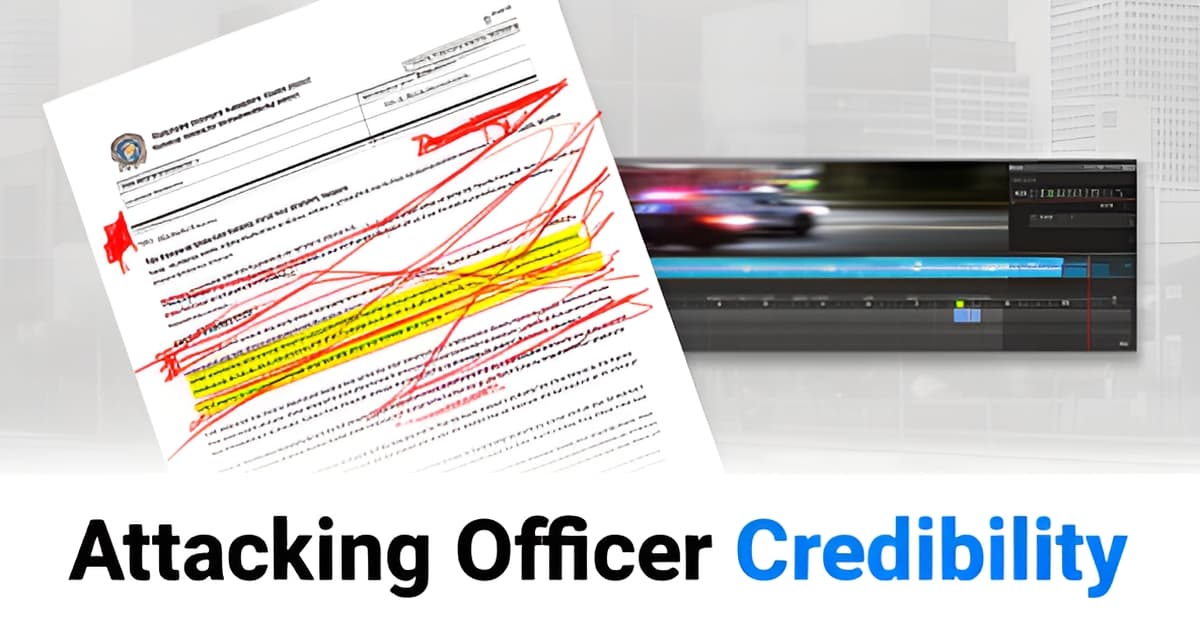
If you want to dismantle officer credibility, you must master the art of the omission. The National Association for Criminal Defense Lawyers identifies inconsistent statements and omissions as the greatest weapons in the defense team's credibility arsenal. This approach works because suppression practice often turns on the officer's trustworthiness, not just legal standards.
Start by asking the "perfect officer" question. What would the ideal officer have included in this report to support their claims? If the answer is missing, you have impeachment material. Treat these gaps as evidence of bias or negligence, not just oversight.
Group your inconsistencies strategically. Place the most material contradictions first, followed by minor discrepancies. This structure builds a cumulative case of unreliability. Use visual aids, such as charts of omissions and contradictions, during oral argument to help the judge see the pattern clearly.
Unsigned documents remain potent tools for impeachment. You can use unsigned police reports and even FBI 302s if you lay the proper foundation under FRE 613. The examiner must have a reasonable basis to believe the statement was made. As noted in judicial education resources, the "sting" of a prior inconsistent statement often survives even if the witness denies it.
The volume of evidence complicates this process. Public defenders often report being overwhelmed by hours of audio and video. Time-indexed transcripts allow you to jump to specific moments and verify report claims against reality. Tools like AI police report analysis automate this comparison, surfacing discrepancies between the written report and bodycam footage. This efficiency ensures you catch every gap, not just the obvious ones.
For teams managing large caseloads, understanding the cost of such tools is essential. Evidence Copilot pricing offers transparent tiers for solo practitioners and public defender offices, making robust evidence review accessible without unexpected overages.
- Identify the "perfect officer" omissions to build your impeachment narrative.
- Order inconsistencies from most material to least to maintain argumentative flow.
- Establish FRE 613 foundation for unsigned reports and 302s before cross-examination.
- Use visual charts to present contradictions clearly during suppression hearings.
Report vs. Bodycam: Building the Structural Attack on AI-Generated Reports
The gap between what a report says and what the bodycam shows is where suppression motions are won. When the report was drafted by AI, that gap is built into the product.
Start every AI-report case with one question at intake: was this report machine-generated? Vendors require an AI-disclosure and officer signature, so the answer is usually on the page. Once confirmed, request the bodycam audio and the edit history immediately. OKCPD's own training data shows roughly half of AI drafts needed missing information filled in by the officer. Each of those fills is a candidate omission to impeach on.
The deeper structural attack targets the audio-only limitation. These tools transcribe speech; they cannot parse or summarize visual content. Officers must narrate in real time. So any visual fact visible on bodycam but absent from the report is a discrepancy by construction, not by mistake. Build a report-vs-bodycam comparison for every AI-drafted narrative and catalog what the camera caught and the officer never said.
Probe the documented failure modes directly. The known weak spots are specific and testable:
- Non-English speakers: an OKCPD AI report captured zero dialogue from a non-English-speaking individual, only the victim's English words (per Chief Redfearn)
- Longer interviews, pursuits, and traffic accidents: customer reports in the ACLU's 2024 white paper cite degraded performance here
- Loud environments and radio chatter: unrelated audio interjects and swamps the narrative
Then attack the bodycam-preview problem, which is the doctrinal ancestor of everything above. If the officer viewed footage before writing, the report reflects the video, not the memory. Research cited by the Los Angeles County Office of Independent Review finds that seeing an event from a new angle alters memory of it. Two departments already restrict this: LASD requires jail deputies to file before viewing, and Oakland bars pre-statement review in Level 1 use-of-force cases.
Independent reviewers rate AI reports significantly worse on accuracy (p = .038), dropping from roughly the 50th to the 36th percentile (study of 92 senior reviewers). Prosecutors know this terrain is untested: OKCPD's outreach to DAs across four counties drew hesitation from half the room, waiting to see how defenders attack these reports in court.
For teams working through hours of bodycam against a single narrative, AI police report analysis surfaces report-vs-bodycam inconsistencies on ingest as unreviewed signals with citations to the exact second of video. Evidence Copilot pricing is published and metered, so case-scale review doesn't run up surprise bills.
Finding Discrepancies at Case Scale: A Grounded Review Workflow
The historical bottleneck isn't the law, it's the volume. Cook County public defenders told JusticeText's founders they were overwhelmed by the amount of audio and video evidence they had to review and the lack of infrastructure in place to help them review it efficiently. A police report discrepancies lawyer who can't actually watch the bodycam isn't finding discrepancies; they're hoping the report contains its own contradictions.
A grounded review workflow fixes that in four steps:
- Ingest the whole discovery dump. Bodycam, dashcam, 911 calls, jail calls, and the police report PDFs go into one workspace. Scanned reports with no text layer get OCR'd so every page is searchable, and every file gets a diarized, word-level timestamped transcript.
- Work from time-indexed searchable transcripts. This is the click-to-playback model JusticeText proved out: click a line of text and the video plays from that exact moment, so you jump to points of interest hidden in hours of footage instead of scrubbing for them.
- Run report-versus-bodycam comparisons with citations. Every claimed discrepancy points to the exact second of video or page of the PDF. That matters for impeachment: before questioning a witness about a prior inconsistent statement, you need a reasonable basis to believe the statement was made, and a proper foundation must be laid even for unsigned reports.
- Surface candidate inconsistencies before anyone asks. On ingest, each new file is compared against earlier evidence in the case, so a report statement that conflicts with the bodycam audio shows up as an unreviewed signal rather than sitting buried until trial prep week.
This matters more now that some reports are machine-written. AI report tools transcribe audio only and cannot parse the video's visual content, so anything an officer didn't narrate aloud can't appear in the report, a structural gap defense counsel can probe (https://cops.usdoj.gov/html/dispatch/01-2025/a i_reports.html). And in OKCPD training, roughly half of AI-generated reports required officers to fill in missing information. Every one of those officer-supplied gaps is a candidate omission.
One guardrail throughout: every AI output in Evidence Copilot is marked AI-generated and pending human review, and the product never makes legal conclusions. It surfaces a quote from the report next to a quote from the footage and cites both. Whether that's material, whether it tips the scales under Commonwealth v. Smith's "smallest feather" standard, stays your call. NACDL's point stands: credibility challenges are a problem of fact, and the attorney's judgment, not the software, does the persuading.
If you want to see the workflow on your own discovery, Evidence Copilot's AI police report analysis page walks through the report-vs-bodycam comparison, and Evidence Copilot pricing is published outright: Solo at $39/user/month, Firm at $99/user/month, and a PD Office tier at $750/attorney/year, all with the full workspace and no feature tiers.
Frequently Asked Questions
How do I find out if a police report was written by AI?
What's the biggest weakness in AI-generated police reports that a defense attorney can attack?
Are AI-drafted police reports actually less accurate than human-written ones?
Can I use an unsigned police report to impeach an officer?
Has any court ruled on whether AI-generated police reports are admissible?
How do I handle hours of bodycam footage when I'm looking for report discrepancies?
The First Mover Sets the Precedent
The landscape for the police report discrepancies lawyer shifted this year, and the fundamentals of credibility work haven't changed, they've just gained a new target. AI-drafted reports carry built-in structural flaws: they transcribe only what an officer narrated aloud, and roughly half required officers to fill in missing information during OKCPD's own training. Every fill is a candidate omission; every unspoken visual fact is a report-vs-bodycam discrepancy by construction. Meanwhile, prosecutors in four counties are openly waiting to see how defense attorneys attack these reports first, no court has ruled on admissibility yet. Whoever tests one in your jurisdiction writes the playbook everyone else argues around. Your next steps are concrete: add "was this report AI-generated?" to your intake checklist, request the bodycam audio and edit history immediately, and build the report-vs-bodycam comparison before trial prep week, not during it. If you want that comparison to happen on ingest, with every discrepancy cited to the exact second of video, AI police report analysis in Evidence Copilot does the heavy lifting, and Evidence Copilot pricing is published outright, starting at $39/user/month. Or book a 20-minute walkthrough and point it at your own discovery. The judgment call stays yours; the gap-finding doesn't have to be manual.