Police Reports Lexisnexis: The Defense Attorney's 2026 Guide
Key Facts
- LexisNexis Police Records Retrieval is legally barred as a consumer report under the FCRA, per LexisNexis Risk Solutions.
- 80% of large police departments have acquired body-worn cameras, according to National Institute of Justice data.
- Police reports are subjective summaries aimed at justifying police actions, warns practitioner guidance on report interpretation.
- Standard police report retrieval takes 3–10 business days, as noted in this accident report guide.
- 1080 HD bodycam footage consumes 3,750–7,550 MB per hour, per NIJ technical specifications.
- LexisNexis covers all 50 states plus territories and Canadian provinces, per Accurint documentation.
- LexisNexis offers roughly 25 non-auto-accident incident report types sharing one workflow, per LexisNexis Insurance Solutions.
The Retrieval Gap: Why LexisNexis Isn't Built for Defense
Every defense attorney eventually searches for police reports lexisnexis in the middle of a case, only to hit a wall that has nothing to do with their research skills. The tool exists, but it wasn't built for you.
LexisNexis Police Records Retrieval (OrderPoint) is a claims product. It's designed for insurance adjusters, fraud investigators, and subrogation teams working vehicle and liability files. The search interface reflects this: you query by VIN, plate number, vehicle owner, or claims history, because the intended buyer is filing a claim, not prepping a suppression motion (LexisNexis Risk Solutions).
The FCRA constraint makes the gap official. LexisNexis states explicitly that Police Records Retrieval does not constitute a "consumer report" and may not be used as a factor in determining eligibility for credit, insurance, employment, or other FCRA permissible purposes. Criminal defense strategy isn't on the list. That legal framing matters because it signals who the product serves and who it doesn't.
Jurisdictional authorization adds another layer. Several agencies require a signed authorization letter from an insurance company designating LexisNexis as a third-party processor before a report gets released at all. Termination codes like "Report Released to Insured Only" or "Signed Release Required" show up when the request path assumes a carrier relationship you don't have (Accurint help documentation). If you're a solo defender or a public defender with no carrier on file, the request dead-ends.
So what does that leave you with?
- Discovery dumps: the police report PDF, bodycam video, dashcam, 911 audio, jail calls, and scanned exhibits the state turns over, usually on its own timeline
- Public records requests and FOIA: slower, jurisdiction-dependent, and frequently redacted before you see them
- Subpoena duces tecum: powerful but expensive to draft and enforce, and overkill for a single incident report
- Direct contact with the agency's records unit: works in some counties, stalls in others
None of these paths give you analysis. They give you documents. The retrieval gap is really an analysis gap: you spend days chasing the report and then hours reading it line by line against 40 hours of bodycam footage to find the two paragraphs where the officer's narrative diverges from what the camera saw.
That divergence is where the case lives. Police reports are subjective summaries aimed at justifying police actions, and they routinely omit details that don't support the officer's narrative (practitioner guidance). The most common flaw isn't dishonesty. It's selective memory filling gaps with assumptions dressed up in official language. Your job is to find those gaps before the state builds on them.
This is the part of the workflow that deserves tooling. Once the report lands in your inbox, whether through discovery or a records request, the clock is running. Uploading the report alongside the bodycam, 911 call, and jail audio into a single review workspace lets you run AI police report analysis that flags candidate inconsistencies on ingest, before you've read a word. Every flag carries a citation back to the exact video second or PDF page, and every flag sits unreviewed until a human confirms it.
For solo defenders and PD offices, Evidence Copilot pricing starts at $39 per user per month and $750 per attorney per year, respectively, with no sales wall and no feature tiers. Compare that to the enterprise procurement cycle behind a claims-oriented retrieval platform, and the practical choice for most defense teams is obvious.
The retrieval gap won't close in 2026. LexisNexis serves a different customer, and the FCRA framing confirms it. Build your workflow around the discovery dump you actually receive and the analysis you actually need to do.
Deconstructing the Narrative: Treating Reports as Subjective Evidence
You pull a police report from LexisNexis or a local records request, and you hold a document that looks objective. It isn’t. The officer wrote it to justify their actions, not to create a neutral historical record.
Attorney Matthew Nezhad describes these documents as "subjective summaries aimed at justifying police actions." He warns that the most common flaw isn’t dishonesty, but selective memory. Officers fill gaps with assumptions dressed up in official language. Legal guides for report interpretation emphasize reading the text like a skeptic, not a believer.
This subjectivity creates a specific target for impeachment. You need to distinguish between what the officer directly observed and what they heard from others. Phrases like "I observed" carry different legal weight than "the driver stated." The report often omits details that contradict the officer’s narrative.
Consider the physical evidence. Body-worn camera adoption is high, with National Institute of Justice data showing 80% of large police departments have deployed the technology. However, the NIJ notes that research on BWC effectiveness is mixed. The footage is not a magic bullet for truth. It requires forensic scrutiny to verify integrity.
When you review a case, you are comparing a written narrative against video reality. The report might say you "resisted." The bodycam might show you were compliant until the officer made contact. These contradictions are the core of your defense strategy. You need to spot them before the preliminary hearing or trial.
Manual review of these inconsistencies is time-consuming and prone to oversight. You are looking for subtle shifts in tone, omitted witness statements, or timing discrepancies between the 911 call and the report.
To streamline this process, many defense teams use AI police report analysis tools. These systems cross-reference the report text against video transcripts and audio files. They flag potential contradictions for your review. The tool highlights where the written summary diverges from the visual record.
You still make the legal judgment. The software just ensures you don't miss the gap.
Here are the common narrative flaws to watch for:
- Omitted details: The report leaves out a witness who contradicts the officer's account.
- Timing discrepancies: The report states an event happened at 10:05 PM, but the bodycam timestamp shows 10:12 PM.
- Secondhand attribution: The officer claims you "admitted" to something, but the 911 call audio shows you only asked a question.
- Selective memory: The officer describes your movements as aggressive, while the video shows you were standing still.
Treating the report as a contested narrative changes how you prepare. You stop accepting the summary as fact. You start treating it as one piece of evidence among many. This shift is critical for building a credible defense.
If you are managing a heavy discovery load, consider how you verify these narratives. Evidence Copilot offers transparent options for solo attorneys and firms. You can review the Evidence Copilot pricing to see if a structured review workspace fits your budget. The goal is to spend less time hunting for inconsistencies and more time building your argument.
The Verification Workflow: Cross-Referencing Reports with Bodycam Footage
A police report says one thing. The bodycam often shows another. With 80% of large departments now using body-worn cameras, defense attorneys have more video evidence than ever to cross-check against written narratives.
The verification workflow starts with treating the report as a subjective summary, not a neutral record. As one legal guide puts it, police reports are "subjective summaries aimed at justifying police actions" that "often omit details that do not support the officer's narrative." Read every line looking for gaps, not facts.
Here's the practical method:
- Extract the officer's narrative into discrete claims: timestamps, locations, observed actions, statements attributed to others.
- Locate the matching bodycam footage for each claim using the report's time window and officer ID.
- Compare each written assertion to the video: does the officer's described observation match what the camera captured?
- Flag discrepancies: timing off by seconds, actions described differently, statements the report attributes to a suspect that never appear on audio.
- Check the footage's metadata for tamper indicators, since NIJ research emphasizes that devices must prohibit editing and use hash values to demonstrate integrity.
The NIJ has found that "research does not necessarily support the effectiveness of body-worn cameras in achieving those desired outcomes," which means video is not a magic bullet for truth. It's a tool that needs forensic handling, just like the report.
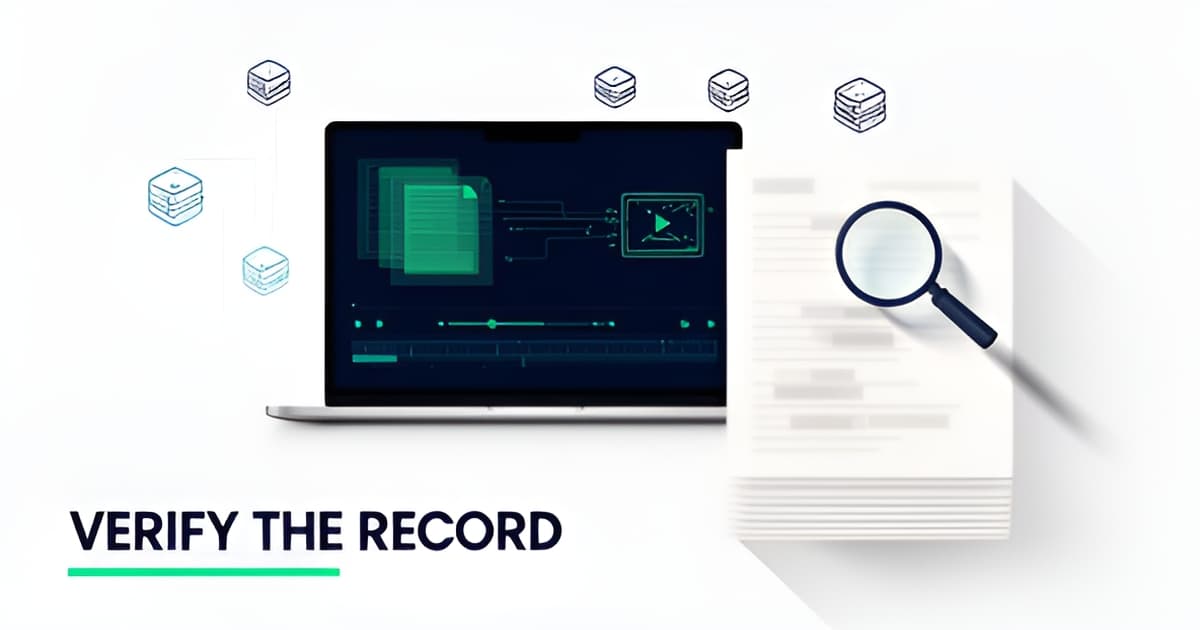
Where this gets practical: once you upload both the report PDF and the bodycam files, automated cross-referencing can surface inconsistencies before you spend hours manually scrubbing video. Tools built for AI police report analysis can flag candidate mismatches on ingest, comparing new evidence against earlier files in the case. Every flagged inconsistency comes with a citation pointing to the exact moment in the video or the exact page in the report, so you verify before you build an argument.
The tamper-resistance check matters for evidentiary motions. If the report describes an event but the video metadata shows a gap, a re-encoding, or a missing hash, that's impeachment material. NIJ guidelines call for verifying metadata and synchronization precisely because courts increasingly expect attorneys to authenticate digital evidence rigorously.
This workflow turns the report-vs-bodycam comparison from a weekend project into a structured review you can complete in an afternoon. The key is treating both artifacts skeptically: the report as a narrative with omissions, the video as data that needs authentication. When they conflict, the discrepancy is your work product.
For solo defenders and PD offices watching their dockets, the bottleneck isn't retrieving reports anymore. It's analyzing them fast enough to file a suppression motion or prep a cross-exam before the preliminary hearing. At $39/user/mo for solo practice or $750/attorney/year for PD offices, the analysis layer costs less than a single transcript service, and it runs every time you upload new evidence.
Accelerating Review: From Manual Scrubbing to AI-Assisted Analysis
You've got the report. Now you've got 40 hours of bodycam, a 911 call, and a jail call to check it against. That's the real bottleneck in police reports lexisnexis workflows: retrieval was never the slow part, cross-checking is.
Retrieval itself takes 3–10 business days through standard channels, and LexisNexis tracks turnaround by jurisdiction and follows up when requests run long, per its Accurint documentation. But once discovery lands, the manual approach breaks down fast. An attorney reading a report against footage has to transcribe, timestamp, and hold both in their head. As one practitioner guide puts it, reports are "subjective summaries aimed at justifying police actions", and the most common flaw is "selective memory" filled with assumptions dressed up in official language (source: Oaks Law Firm's guide). You can't catch selective memory by skimming.
The scale problem is real, too. According to NIJ research, 80% of large police departments have acquired body-worn cameras, and HD footage runs 3,750–7,550 MB per hour. Every one of those files is a potential contradiction of the report sitting next to it in your case folder.
A practical implementation strategy looks like this:
- Ingest everything into one workspace. Upload the report PDF, bodycam, 911 audio, and jail calls so transcription, OCR, and document text live in the same case.
- Let the system compare new files against existing evidence on ingest, surfacing candidate inconsistencies (report vs. bodycam, statement vs. call audio) as review signals before anyone asks.
- Verify every flagged inconsistency by clicking through to the exact video second or PDF page. A flag is a lead, never a conclusion.
- Draft cross-exam questions from the verified signal, with both sides' quotes tied to their sources, then review as the attorney.
The value isn't automation replacing judgment. It's citation-backed flags that point you to the precise moment worth watching, so your hour goes to evaluating the inconsistency instead of hunting for it. Evidence Copilot's approach to AI police report analysis works this way: every AI output is marked as pending human review, and originals stay immutable, which also matters for the NIJ's tamper-resistance standards around hash values and metadata integrity.
That human-in-the-loop framing matters for ethics rules, and so does cost transparency. You can review Evidence Copilot pricing before committing anything: Solo runs $39/user/month, and PD offices pay $750 per attorney per year, with every plan including the full workspace. A 7-day full-access trial and a 14-day money-back guarantee mean you can test the workflow on a live case before deciding whether it earns a place in your practice.
Frequently Asked Questions
Can defense attorneys actually use LexisNexis to get police reports?
Why are police reports considered subjective instead of factual?
Is bodycam footage reliable enough to disprove a police report?
How long does it take to get a police report through standard channels?
What's the fastest way to find inconsistencies between a police report and bodycam footage?
How much does AI evidence review cost compared to enterprise retrieval tools?
From Retrieval Bottleneck to Trial-Ready Analysis
The LexisNexis police reports workflow in 2026 still ends where it began: with a PDF in your inbox and a bodycam timeline you have to verify by hand. Retrieval is a solved problem for insurance adjusters, but defense teams operate under different constraints, different timelines, and a different legal standard. Once you accept that the report is a contested narrative rather than a neutral record, the real work begins: extracting every claim, matching it to the footage, and flagging the gaps before the state builds on them. That work does not require enterprise procurement or carrier authorizations; it requires a workspace where the report, the video, the 911 call, and the jail audio live together and surface their own contradictions on ingest. Evidence Copilot is built for that step, with AI police report analysis that cites every flag back to the exact video second or PDF page, and with published pricing starting at $39 per user per month for solo practice. Start a 7-day full-access trial on a live case, or book a 20-minute walkthrough to see how the workflow fits your docket.